
Grammar: Non-binary Adjective & Noun Endings in French
part one of...probably many :)

Bonjour à toustes !
Welcome back to another grammar installment of The Educator’s Guide to Nonbinary French. Happy Enby French Guide Friday!! This week, I’m going to present some suffixes that are neither masculine nor feminine in French - they’re morphologically distinct. You can use these to supplement (or replace) l’écriture inclusive in whatever combination feels good to you. An advantage of these suffixes is that they are distinguishable when spoken aloud, which is not always the case for inclusive writing.
As with all of these grammar newsletters, my goal is not to give you another prescriptive structure to follow. French has quite enough of those already, and one of the main points of non-binary French is to embrace multiplicity and plurality of language. Rather, I am here to give you options and possibilities that currently are being used in Francophone queer spaces. It’s up to you where and how you use them. The fact that there are many choices does not mean that modeling this language is less important. Blase A. Provitola writes in the H-France Salon 2019 issue:
“What foreign language teachers model for their students in the classroom influences what they perceive as acceptable or possible to express. Drawing attention to those possibilities, their limits, and how they are being questioned emphasizes that these linguistic issues are political ones, which continually influence which forms of subjectivity are lent legitimacy. Even seemingly small shifts in classroom policies and practices can make a huge difference for transgender students who are already painfully aware of these questions” p. 5
Where does one find these suffixes?
I started looking at these resources back in 2021 as I was getting ready to teach French language at the university level for the first time. I was openly non-binary and I was using non-binary pronouns in English at the time. I wanted to make sure that my students would feel included and represented, and that I would too. I started googling and found a couple youtube videos, and then I looked in academic journals and publications. After I found a few key authors, I poured over their bibliographies and expanded my repertoire. There are a few articles/books that I come back to over and over again, four years later.
Here they are for you to explore as you wish:
Alpheratz. “Français inclusif : conceptualisation et analyse linguistique.” SHS web of conferences, vol. 46, EDP Sciences, 2018.
Check out their website
Ashley, Florence. “Les personnes non-binaires en français : une perspective concernée et militante” H-France Salon, vol. 11, no. 14, 2019.
Knisely. (2020a). Le français non-binaire: Linguistic forms used by nonbinary speakers of French. Foreign Language Annals, 53, 850-876. DOI: 10.1111/flan.12500
Provitola, Blase A. ““Faut-il choisir ?”: Transgender Access to the French Language Classroom.” H-France Salon, vol. 11, no. 14, 2019.
Swamy, Vinay, and Louisa Mackenzie. Devenir non-binaire en français contemporain. Éditions Le Manuscrit, Paris, 2022.
Personally, I draw a lot of the morphology I use from French linguist Alpheratz and their système “al”. This system uses “x” (often for singular) and “z” (often for plural) - did you know that “z” was a more common ending in ancien français?? (I’ll get to that in a future installment :)) - to mark suffixes with elements that are neither masculine nor feminine. I also follow in the work of Dr. Florence Ashley, who explains a modular approach and proposes their own response to Alpheratz’ system, and Dr. Kris A. Knisely’s 2020 study about attitudes and comprehensibility of gender-just language. Below is a combination that I have adapted the past few years, informed most recently by Dr. K. A. Knisely and Dr. E. L. Russell’s 2024 publication, Redoing linguistic worlds: Unmaking gender binaries, remaking gender pluralities.
Which suffixes do I use the most for adjective/noun endings?
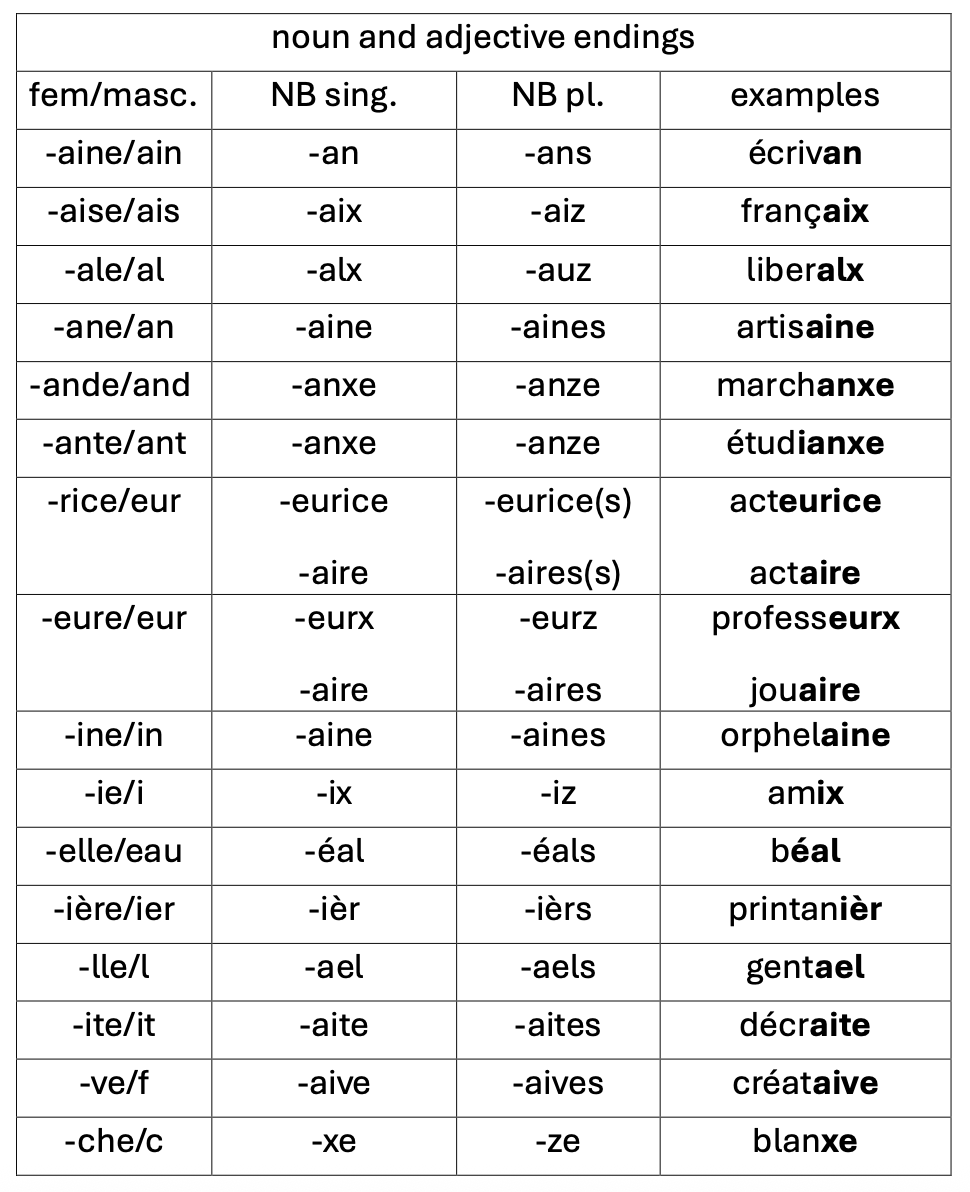
Next week, it’s Fun Facts time again (yayyyy!) and I’ll be sharing some really beautiful gender-affirming quotes from 19th century France.
Don’t forget to check out our podcast!
As always, I’d love to hear from you! What forms do you use for yourself or in your classrooms? Feel free to comment on this post, reach out on insta @enbyfrenchguide or via email at enbyfrenchguide@gmail.com.
À la semaine prochaine !
Your EFG